
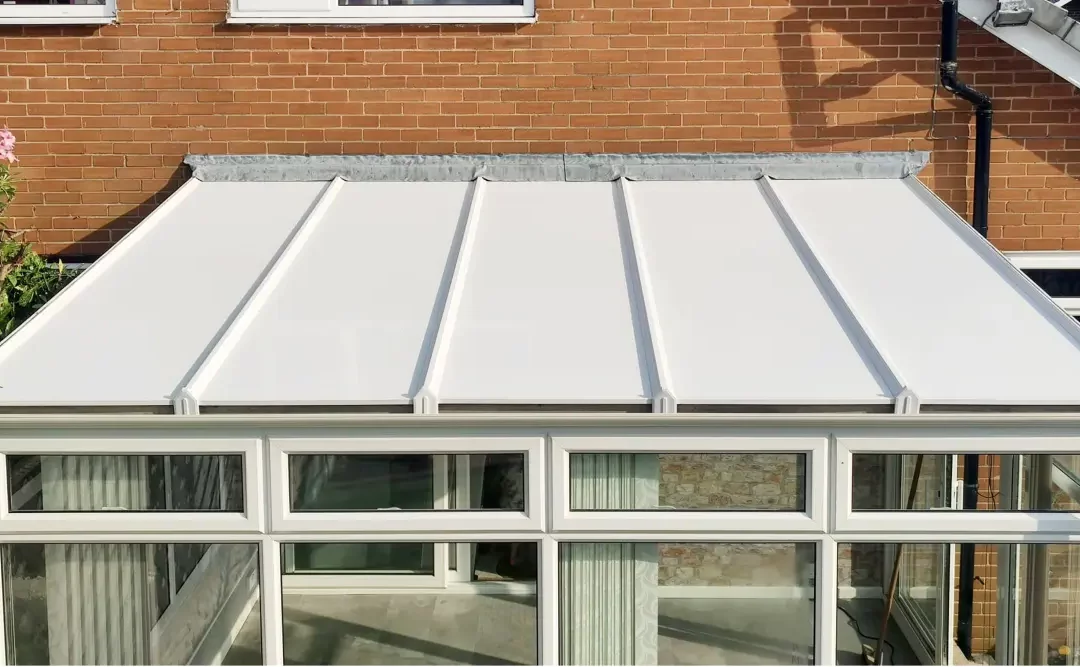
It’s April. You’re still reaching for a jacket on the way to the shops, but the sun has a different quality to it now — brighter, more direct — and on a clear afternoon it catches the conservatory roof in a way it simply didn’t all winter.
You step inside expecting it to feel pleasant. Instead, it’s stuffy and warmer than it should be. Not unbearable — but noticeably uncomfortable for a day when everyone outside is still wearing a coat.
It’s a small thing now. By June, it won’t be small at all.
Every spring, thousands of UK homeowners start searching for answers to the same question:
“Why is my conservatory already getting too warm — it’s not even summer yet?”
The answer is almost always the same. And the good news is, it’s fixable — without tearing your roof off, without spending £12,000, and in many cases, without even hiring a builder.
Here’s a plain-English guide to the questions we’re asked most at ThermoPanels every spring, and what you can actually do about them.
Why does my conservatory overheat even in April?
Solar energy doesn’t care what the calendar says. The moment the sun climbs higher in the sky — which starts happening from March onwards in the UK — sunlight hits your conservatory roof at a more direct angle than it did all winter.
If your roof is made of polycarbonate or older glass, it acts less like a building material and more like a lens. Sunlight floods in, heats up the floor, the furniture and the air inside — and because the space is enclosed, that heat has nowhere to go. The result is what industry professionals call the greenhouse effect: temperatures inside your conservatory can easily be 15–20°C higher than outside on a sunny day, even in early spring.
As the season progresses, that gap widens. By midsummer, a conservatory with a poor roof can easily run 10–15°C hotter than outside — enough to make it genuinely unpleasant to spend any time in.
The root cause isn’t the sun. It’s the roof.
Conservatory too hot in summer and too cold in winter — is this just how it is?
No. And this is perhaps the most important thing to understand.
The “too hot in summer, too cold in winter” problem is not an inherent flaw of conservatories. It is a flaw of outdated roofing materials.
Polycarbonate — the semi-transparent corrugated material used on the vast majority of conservatories built in the 1990s and 2000s — has a thermal U-value of around 2.4 W/m²K. That means heat passes through it freely, in both directions. In winter, warmth leaks out. In summer, solar heat pours in. It does neither job well.
Modern insulated roof panels, by contrast, can achieve U-values as low as 0.15 W/m²K — roughly sixteen times more thermally efficient than the polycarbonate they replace.
That difference is not marginal. It is the difference between a room you avoid and a room you actually use. Research suggests the average UK conservatory with a poor roof sits unused for around 248 days of the year. That is eight months of wasted space — space you are heating, cooling, and maintaining.
Can a conservatory genuinely be used all year round in the UK?
Yes — when the roof is right.
The UK climate is not the barrier. We are not particularly extreme by global standards. What makes conservatories uncomfortable is not the weather; it is the gap between what the weather demands and what the roof can deliver.
A conservatory with an insulated roof can maintain a stable, comfortable internal temperature across all four seasons. In spring and summer, the insulation slows down solar heat gain, preventing the space from becoming unbearable. In autumn and winter, the same insulation retains warmth rather than letting it bleed out overnight.
Thousands of UK homeowners have made this discovery and describe the transformation as like gaining an entirely new room in their home. A space they previously used from May to September — and even then, only on cooler days — suddenly becomes a home office, a dining room, a playroom, a reading space they can use every day of the year.
What can I replace my polycarbonate conservatory roof with?
You have three main options, each at a different price point and commitment level.
Option 1: Insulated roof panels (like ThermoPanels)
This is the most accessible and least disruptive upgrade. Insulated panels — typically made with a rigid XPS foam core bonded between durable PVC-UV outer faces — are designed to slot directly into your existing roof framework, replacing the old polycarbonate panels one by one.
No structural work is required. No scaffolding. No planning permission for like-for-like panel replacement. No builder needed if you’re comfortable with DIY.
The result is a roof that looks clean and finished, dramatically reduces heat gain in summer, retains warmth in winter, and — crucially for many homeowners — cuts the noise of rainfall on the roof by a significant margin.
ThermoPanels’ panels start from £75 (excl. VAT), making this the most cost-effective route to a transformed conservatory.
Option 2: Internal insulated ceiling
Rather than replacing the external panels, you can add an insulated ceiling layer internally — fitted beneath the existing roof structure using interlocking PVC panels with insulation behind them. This works particularly well when combined with external ThermoPanels for maximum performance (a dual-insulation approach can achieve U-values of 0.15 W/m²K).
Typical installed cost from a trade professional: £1,500–£4,500.
Option 3: Full solid roof replacement
The most comprehensive upgrade — replacing the entire roof structure with a tiled or insulated solid roof. This offers the highest thermal performance and can add meaningful value to your home. However, it is also the most expensive (typically £5,000–£15,000+), the most disruptive, and — importantly — it usually requires building regulations approval, since a solid roof technically reclassifies your conservatory as a full extension.
For most homeowners who want their conservatory to work better without a major building project, Options 1 and 2 deliver excellent results at a fraction of the cost and disruption.
How much does conservatory roof insulation cost in 2026?
Here is an honest breakdown:
| Solution | Typical cost | DIY possible? | Planning needed? |
|---|---|---|---|
| ThermoPanels insulated panels (supply only) | From £75/panel | Yes | No (like-for-like) |
| Internal insulated ceiling (installed) | £1,500–£4,500 | Possible | No |
| External panel replacement (installed) | £2,500–£6,000 | Possible | No |
| Full solid roof replacement | £5,000–£15,000+ | No | Usually yes |
The right choice depends on your budget, your confidence with DIY, and how dramatically you want to improve the space. If you are simply looking to stop the room becoming unusable in summer and draughty in winter, insulated panel replacement delivers a significant, tangible improvement at a manageable cost.
If you are converting your conservatory into a permanent living room or home office — somewhere you will use all day, every day — a full roof replacement may be the better long-term investment.
Do I need planning permission to replace my conservatory roof panels?
For like-for-like panel replacement — swapping old polycarbonate panels for insulated panels within the same existing framework — you generally do not need planning permission or building regulations approval. You are replacing materials, not altering the structure.
The situation changes if you are moving to a fully solid tiled roof, because that changes the legal classification of the structure. Building regulations approval is then typically required to demonstrate that the new roof meets thermal performance standards (a U-value below 0.18 W/m²K under Part L).
If you live in a listed building, a conservation area, or a property where permitted development rights have been removed, always check with your local planning authority before starting any work. When in doubt, a quick call to your council’s planning department costs nothing and can save significant headaches later.
Why is my conservatory dripping with condensation after winter?
Condensation forms when warm, moist air comes into contact with a cold surface. In conservatories, the roof is usually the coldest surface — which means it is the primary condensation point.
If your roof has poor insulation, the internal face of the panels will be close to outside temperature. The moment the conservatory warms up — from a heater, from people using the space, from morning sunlight — moisture in the air condenses on the cold panels and drips.
Improving roof insulation raises the internal surface temperature of the roof, dramatically reducing the temperature differential that causes condensation. Homeowners who upgrade to insulated panels consistently report that the persistent dripping they experienced — and the associated damp and mould — disappears almost entirely.
If you also have condensation between panes in your window glazing units, that is a separate issue (failed glazing seals) and requires glazing replacement rather than roof work.
Why spring is the right time to sort this
There is a practical reason to act now rather than waiting until July.
Installation demand for conservatory upgrades rises sharply through late spring and into summer, as more homeowners encounter the overheating problem and want it fixed immediately. Lead times lengthen, installer availability shrinks, and the best solutions can be unavailable when you need them most.
Acting in April means your conservatory is ready before the weather properly arrives. You gain the full benefit of the warmer months — rather than spending the first half of summer still planning the fix.
ThermoPanels’ standard white PVC panels are held in stock and available for immediate collection from our warehouse in Brentwood, CM150TB. If you prefer delivery, we work with independent couriers — simply include your address in the enquiry form and we’ll arrange a quote. Delivery typically takes 3–10 working days from the date the order is placed. Please note that customers in Scotland, Wales and Cornwall should contact us for a separate delivery quote. If you’d like professional installation rather than DIY, we work closely with a trusted team of engineer-installers — we’re happy to refer you to Efficway.co.uk.
Ready to transform your conservatory this spring?
If your conservatory has already started to feel uncomfortable — or you know from experience what it’s like by June — the roof is almost certainly where to start.
ThermoPanels supplies high-quality insulated roof panels to UK homeowners, DIY installers, and trade professionals. Our panels are lightweight, easy to cut and fit, UV-resistant, and engineered to deliver year-round thermal performance in the British climate.
Request a personalised quote by completing the enquiry form on our website — include your conservatory dimensions and we’ll come back to you with pricing. Panels start from £75 (excl. VAT).
We also supply in bulk for trade customers and renovators working across multiple properties.
Get a quote → | View our panel range →
ThermoPanels supplies insulated conservatory roof panels to homeowners and trade professionals across the UK. Panels are available for immediate collection from our Brentwood, RM18 warehouse, or via independent courier delivery (3–10 working days). Free delivery to most of England — please contact us for a quote if you are in Scotland, Wales or Cornwall. Professional installation referrals available via Efficway.co.uk.