
Millions of UK homes have polycarbonate conservatory roofs — but most homeowners don’t realise how much comfort, energy, and money they are losing every single year.
If your conservatory is an oven in summer, a freezer in winter, and sounds like a drum kit whenever it rains, there is a very good chance it still has its original polycarbonate roof. Polycarbonate was once the go-to glazing material for conservatory roofs because it is lightweight and inexpensive to manufacture. However, its limitations have become increasingly hard to ignore — and understanding those limitations is the first step to solving them.
In this guide we break down every significant disadvantage of polycarbonate conservatory roofing, explain what makes glass roofs only a partial improvement, and show you why more and more homeowners are choosing ThermoPanels insulated conservatory roof panels as the definitive upgrade.
Table of Contents
The main disadvantages of a polycarbonate conservatory roof
1. Extreme temperature swings — too hot in summer, too cold in winter
Polycarbonate has very poor thermal performance compared to modern insulated roofing materials. Its U-value (a measure of heat loss) is typically around 1.8–3.5 W/m²K, meaning heat escapes rapidly in winter and solar energy becomes trapped in summer, turning the conservatory into a greenhouse. In winter, any heat generated inside escapes just as readily, making the space expensive to keep warm and uncomfortable to use.
The result: Most polycarbonate-roofed conservatories are genuinely usable for only a few months of the year — a significant waste of what could be one of the most valuable rooms in your home.
2. Noise — rain, hail, and wind amplification
Polycarbonate is thin, hollow, and resonant. Even light rainfall can create a significant noise inside the conservatory, and a heavy downpour or hailstorm makes conversation virtually impossible. This is one of the most common reasons homeowners seek a conservatory roof replacement — the noise alone makes the room unusable during poor weather, which in the UK means a considerable portion of the year.
3. Discolouration and yellowing over time
UV radiation gradually degrades polycarbonate at a molecular level. Despite UV-resistant coatings, most polycarbonate conservatory roofs begin to yellow, cloud, or become brittle within 10–15 years. This discolouration significantly reduces light transmission and gives the conservatory a tired, dated appearance. Once the material has degraded in this way, it cannot be reversed — replacement is the only option.
4. Condensation and moisture issues
The large temperature differential between the inside and outside surfaces of polycarbonate sheets creates the perfect conditions for condensation. Water can accumulate inside the hollow cells of twin-wall or multi-wall polycarbonate, leading to algae growth, streaking, and a permanently murky appearance. Internal condensation between layers is impossible to clean and signals that the roof panel has reached the end of its functional life.
5. Poor energy efficiency and higher heating bills
Because of its weak thermal properties, a polycarbonate conservatory roof forces your heating system to work far harder during colder months. Any heat radiating from your home’s interior is conducted straight out through the roof. Homeowners who add underfloor heating or radiators to a polycarbonate-roofed conservatory often find that running costs are disproportionately high relative to the comfort achieved.
6. Limited lifespan
Even with good maintenance, a polycarbonate conservatory roof typically has a useful life of around 10–15 years before the thermal performance, appearance, and structural integrity deteriorate noticeably. This makes it one of the shorter-lived roofing options available — and the cost of eventual replacement should be factored in when comparing it to longer-lasting alternatives.
7. Difficulty cleaning and maintaining
Polycarbonate scratches easily, meaning it cannot be cleaned with abrasive tools. Dirt, algae, and green mould accumulate in the fluted channels of multi-wall sheets and are extremely difficult to remove without specialist equipment. Over time, even a well-maintained polycarbonate roof will look noticeably dirtier than a glass or solid panel alternative.
What about glass conservatory roofs — are they better?
Glass roofs represent an improvement over standard polycarbonate in several respects — they don’t yellow, they are easier to clean, and they can look more attractive. However, glass conservatory roofs share some of the same fundamental problems:
- Standard double-glazed glass still allows significant solar gain in summer, causing overheating unless specialist solar-control glass is specified at considerable extra cost.
- The weight of a glass roof often requires structural reinforcement to the existing conservatory frame, adding to the total project cost.
- Premium solar-control or triple-glazed glass options come at a significantly higher cost than a solid panel alternative.
ThermoPanels offer a lightweight, cost-effective alternative that improves on standard polycarbonate performance while being straightforward to install on most existing conservatory frames.
Why upgrade to ThermoPanels?
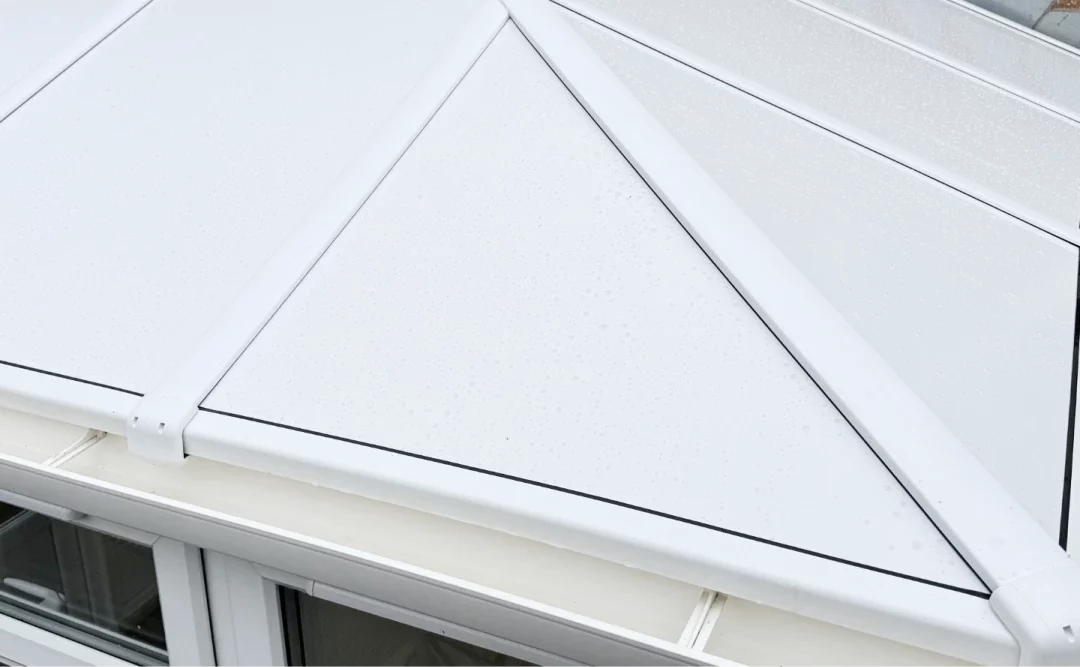
ThermoPanels are solid insulated roof panels that offer a practical and cost-effective upgrade for conservatory roofs. Combining a closed-cell XPS insulated core with a durable, UV-resistant PVC outer layer, they deliver noticeably better temperature control, reduced rain and hail noise, and improved weather resistance compared to polycarbonate and glass alternatives — helping you get more use out of your conservatory throughout the year.
Why homeowners and contractors choose ThermoPanels
- Weather and UV resistant: ThermoPanels are built to withstand the full range of UK weather conditions. The PVC top layer is UV-resistant and humidity-resistant, meaning the panels will not yellow, warp, or degrade over time the way polycarbonate inevitably does.
- Enhanced impact resistance: The panel construction offers improved impact resistance compared to standard polycarbonate sheeting, making it a more durable long-term roofing solution.
- Improved temperature control: The XPS insulated core significantly reduces heat transfer, keeping your conservatory cooler in summer and warmer in winter — a major step up from the temperature extremes that polycarbonate roofs are notorious for.
- Energy-efficient and cost-effective: Better thermal performance means your heating system works less hard in colder months, helping to reduce energy bills over time.
- Lightweight and easy to install: ThermoPanels are lightweight and easy to cut, making them straightforward to handle and fit on most existing conservatory frames — without the need for structural reinforcement that heavier roofing alternatives can require.
- Reduced rain and hail noise: The solid panel construction absorbs external noise rather than amplifying it, noticeably reducing the drumming sound that makes polycarbonate roofs so disruptive during rain or hail.
- Minimised glare and furniture fading: Unlike clear polycarbonate or glass, ThermoPanels reduce solar glare and help protect your furniture and flooring from UV-related fading.
- Suitable for polycarbonate and glass roof replacements: Whether your existing conservatory has a polycarbonate or glass roof, ThermoPanels can be specified to suit your project.
Get a ThermoPanels quote for your conservatory
ThermoPanels supplies UK homeowners and trade customers. Whether you are a homeowner planning a DIY upgrade or a contractor working on multiple projects, the team can help you specify the right panels for your conservatory roof.
You can get a quote for your project by visiting ThermoPanels website and submitting an enquiry via contact form. Here is the link: ThermoPanels Contact Form
Frequently asked questions
Can I replace a polycarbonate conservatory roof myself?
Many homeowners do replace polycarbonate sheets with solid insulated panels as a DIY project. ThermoPanels are designed to be installer-friendly, but you should always check that your conservatory frame is structurally sound before beginning work.
Do I need planning permission to replace a conservatory roof?
In most cases, replacing a conservatory roof with a like-for-like or improved roof covering falls within permitted development rights in England and Wales, meaning planning permission is not required.
How long does a ThermoPanels conservatory roof replacement take?
Most conservatory roof replacement projects using ThermoPanels can be completed in one to two days by an experienced installer. The lightweight nature of the panels makes handling and fitting significantly quicker than heavier tile or glass alternatives.
Will replacing my polycarbonate roof add value to my home?
A solid insulated conservatory roof upgrade is widely considered to add usable living space to your home, which is generally reflected positively in property valuations. An energy-efficient, year-round usable conservatory is a far more attractive proposition to buyers than a seasonal sun room that is uncomfortable for most of the year.
Are ThermoPanels suitable for glass conservatory roofs as well as polycarbonate?
Yes. ThermoPanels can be used to replace both polycarbonate and glass conservatory roofs. If your glass roof is ageing, leaking, or simply failing to deliver adequate thermal performance, ThermoPanels offer a cost-effective and thermally superior alternative.
Summary — is it time to replace your polycarbonate conservatory roof?
If your conservatory is unusable in extreme weather, noisy in the rain, or costing you more to heat than the rest of your home put together, your polycarbonate roof is almost certainly the root cause. The disadvantages of polycarbonate — poor insulation, noise amplification, UV degradation, condensation, and short lifespan — are not problems that can be managed indefinitely. They are structural limitations of the material itself.
A conservatory roof replacement with ThermoPanels is one of the most impactful home improvements you can make. It transforms an underused seasonal space into a genuine year-round room, dramatically reduces energy consumption, and eliminates the noise and condensation issues that make polycarbonate roofs so frustrating to live with.
To find out more about ThermoPanels and get a quote for your project, visit https://thermopanels.co.uk — and take the first step towards the conservatory your home deserves.
Efficient UK Supply
We hold UK stock for white PVC-UV insulated conservatory roof panels. Coloured panels are available as a special request for bespoke projects.
ThermoPanels are perfect not only for conservatory roof insulation but also for various insulation projects where higher thermal efficiency is essential.