
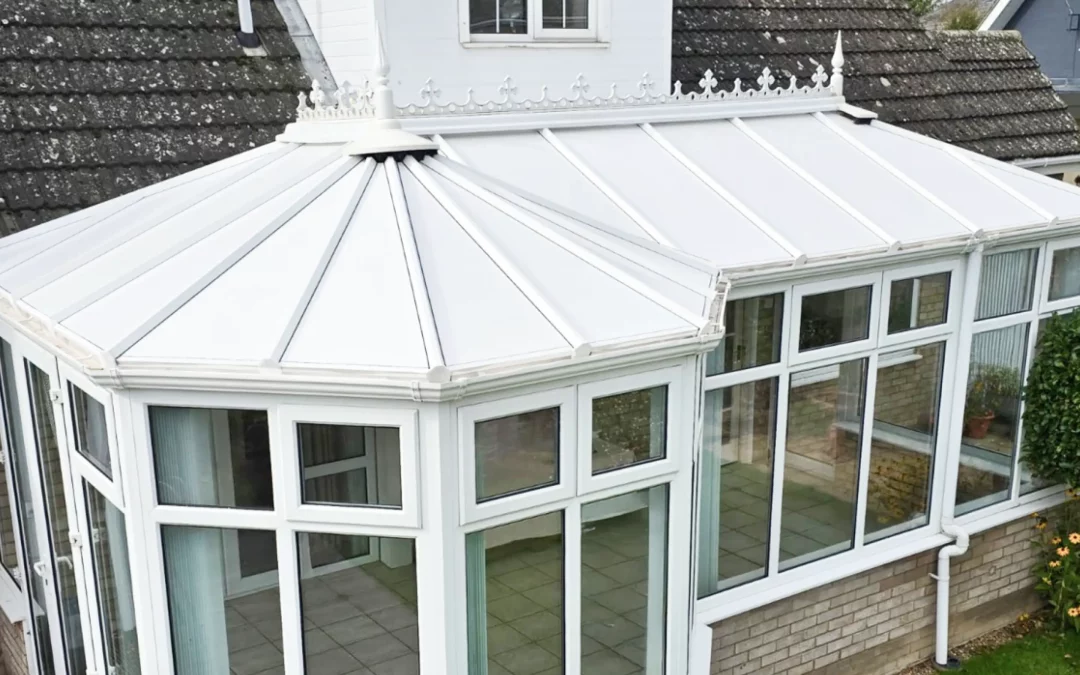
Upgrading a conservatory roof is one of the most effective ways to improve year-round comfort.
But many homeowners and installers still ask:
- What thickness do I need?
- Does thicker always mean better?
- What do U-value and R-value actually mean?
- Are insulated panels really better than glass or polycarbonate?
In 2026, energy efficiency and thermal stability are more important than ever. This guide explains how ThermoPanels work and how to choose the right option for a conservatory roof insulation project.
Table of Contents
What Are ThermoPanels?
ThermoPanels are high-performance insulated sandwich panels.
Each panel consists of:
PVC-UV Top & Bottom Layers (White Finish)
- Thickness: 1.0–2.0 mm
- Density: 1450 kg/m³ (ISO 1183)
- Water absorption: 0.2% (DIN 53495)
- Fire rating: Bs2d0 (EN 13501-1)
XPS Insulated Core (Closed-Cell Structure)
- Density: ≥33 kg/m³ (EN 1602)
- Thermal conductivity: λ 0.034 W/mK (EN 13164)
- Water absorption: <1% (EN 12087)
- Fire rating: E (EN 13501-1)
This layered construction creates a strong thermal barrier while remaining lightweight and structurally compatible with conservatory glazing systems.
Standard panel sizes range from 2000 × 1000 mm to 4000 × 2000 mm, with thicknesses from 16mm to 35mm. Custom options are available on request.
Understanding Thermal Performance
When choosing insulation panels, three values matter:
1️⃣ U-Value – Heat Loss
The U-value measures how much heat passes through a material.
Lower = better insulation.
Reducing the U-value means:
- Less heat escaping in winter
- More stable internal temperatures
- Improved energy efficiency
2️⃣ R-Value – Thermal Resistance
R-value measures resistance to heat flow.
Higher = better insulation.
R-value increases as thickness increases — because there is more insulated core resisting heat transfer.
3️⃣ λ (Lambda) – Thermal Conductivity
ThermoPanels use XPS with:
λ 0.034 W/mK
This indicates strong thermal resistance for an insulation core material.
Lower λ value = slower heat movement through the material.
Because the XPS core is closed-cell and moisture resistant, performance remains stable over time — even in changing UK weather conditions.
What This Means in Practice
Because ThermoPanels use XPS with λ 0.034 W/mK, increasing panel thickness directly increases thermal resistance (R-value) and lowers heat transfer (U-value).
In simple terms:
- Thicker panel → Less heat escaping
- Lower U-value → Better insulation
- Higher R-value → Greater temperature stability
This allows conservatories to retain warmth more effectively during colder months and reduces extreme temperature fluctuations throughout the year.
Thickness Guide: Choosing the Right Panel for Your Conservatory
For most conservatory roof insulation projects, panel thickness corresponds to the thickness of the existing polycarbonate panels currently installed.
This ensures:
- Correct fit within existing glazing bars
- Proper sealing
- Structural compatibility
- Smooth replacement process
The key principle is simple:
The thicker the insulated XPS core, the stronger the thermal resistance.
ThermoPanels are available in:
🔹 16mm
Designed to replace 16mm polycarbonate systems while delivering improved insulation.
🔹 25mm
A widely selected option for conservatory upgrades, offering enhanced insulation and improved comfort.
🔹 28mm / 32mm
Used where the existing roof system accommodates these thicknesses, providing increased thermal performance.
🔹 35mm
Delivers high insulation performance within the standard range for compatible conservatory systems.
There is no downside to increased thickness from a thermal perspective — thicker panels simply provide higher insulation performance when structurally appropriate.
Polycarbonate vs Glass vs ThermoPanels
Traditional conservatories were often built with polycarbonate or glass roofing.
However, these materials lack a solid insulated core.
Compared to polycarbonate and glass, ThermoPanels offer:
- Higher thermal resistance
- Reduced heat transfer
- Lower condensation risk
- Reduced rain and hail noise
- Greater year-round temperature stability
The key difference is structural:
Polycarbonate = hollow plastic sheets
Glass = glazed panels
ThermoPanels = solid insulated XPS core with protective PVC-UV layers
That solid core is what changes thermal behaviour dramatically.
Why Thermal Upgrades Matter in 2026
With continued energy cost pressures across the UK, homeowners are focusing on insulation efficiency rather than increasing heating use.
Improved conservatory roof insulation can:
- Reduce heating demand
- Minimise temperature fluctuations
- Improve everyday comfort
- Increase usability throughout spring, autumn and winter
Instead of being a seasonal space, the conservatory can function as a genuine extension of the home.
Designed for Conservatory Roof Insulation
ThermoPanels are great for conservatory roof upgrades.
By matching the thickness of the existing polycarbonate panels, installation remains straightforward while delivering a substantial improvement in thermal performance.
The result:
- Better insulation
- Greater comfort
- Reduced energy transfer
- Long-term durability
Final Thoughts
Choosing the right insulation panel is not simply about selecting a product — it’s about understanding how thickness, core material and thermal conductivity work together.
ThermoPanels combine:
- Closed-cell XPS core (λ 0.034 W/mK)
- Moisture resistance
- Structural compatibility
- Multiple thickness options (16mm–35mm)
For conservatory roof insulation projects, selecting the appropriate thickness — matched to the existing roof — ensures optimal performance and seamless installation.
In 2026, insulation isn’t just an upgrade.
It’s an essential part of creating a comfortable, energy-efficient living space.
Efficient UK Supply
We hold UK stock for white PVC-UV insulated conservatory roof panels. Coloured panels and custom thickness are available as a special request for bespoke projects.
ThermoPanels are perfect not only for conservatory roof insulation but also for various insulation projects where high thermal efficiency is essential.
Visit our website and fill in the enquiry form to request a quote today.